We are two old high school friends who re-connected in our fifties. We fell in love all over again and then hit the road to explore and create art inspired by our travels. We purposefully seek Chance Encounters with people, music, food and the natural landscape to inspire us. We hope we can take you with us on our journey of continuous learning, spiritual growth and creative expression and invite you to view our art work at https://barbarawentzelljaquith.com/subscribe
Author: Barbara Wentzell Jaquith
WE ARE TWO HIGH SCHOOL FRIENDS WHO RECONNECTED IN OUR FIFTIES. WE FELL IN LOVE ALL OVER AGAIN AND THEN HIT THE ROAD TO EXPLORE AND CREATE ART INSPIRED BY OUR TRAVELS. WE PURPOSEFULLY SEEK CHANCE ENCOUNTERS WITH PEOPLE, MUSIC, FOOD AND THE NATURAL LANDSCAPE TO INSPIRE US. WE HOPE WE CAN TAKE YOU WITH US ON OUR JOURNEY OF CONTINUOUS LEARNING, SPIRITUAL GROWTH AND CREATIVE EXPRESSION AND INVITE YOU TO VIEW OUR ART WORK AT HTTPS://BarbaraWentzellJaquith.com.
Artist Statement
The starting point for each of my works is a shape or movement that I have observed in nature. From there, I think about integrating two or more mediums to translate what I have seen into a piece of art that will create questions. I consider it a great privilege when someone is moved to acquire something I have created for their own home or workspace.
EDUCATION
My BA, “Creative Expression in Society”, was granted by the University of New Hampshire at Plymouth. This Interdisciplinary degree melded art, psychology and social work to explore how humans interact with their world and express their experiences creatively.
EXPERIENCE
I currently divide my creative time between my studio in Conyers, Georgia and RV travel for Plein Aire opportunities. Exhibition experience includes showings at the Cayman Gallery, The Octagon Arts Center, Grinder Gallery and a one-person show at Stone Soup Gallery in Key West. My work was also included in Crossroads: Change in Rural America (Smithsonian Institution Traveling Exhibition with Georgia Humanities).
FOCUS AND MEDIUM
I routinely move back and forth between an abstract style and realism to explore both sides of life’s questions. In 2024 I began working in pastels once again.
I have long believed that the power of art lies in its ability to raise important questions. Art that raises questions aids introspection, both personal and social, and can move us forward in our critical thinking. And critical thinking has never been more important in our society than right now!
I recently reread a good book on my shelf that has gathered dust for some time. In Warren Berger’s book, The Book of Beautiful Questions the “questionologist” asserts that good questions can be catalysts and create forward movement. They can be transforming and life changing. Questions can surprise, disturb, excite, inspire, and nudge us. They can act as a lighthouse that illuminates where we need to go next.
When I stand in front of a blank white canvas ready to start a new piece, it is always time to wrestle with important questions. “Who will this piece say that I am? Does it surprise, disturb, excite, inspire or nudge? How will this piece help me relate to others? Who will this piece speak to? Will it speak to the already joyful, stable and healthy? Or will it speak to those who may be broken, fearful, doubting, oppressed, marginalized?”
As artists, our creative call is to pay attention, to notice, to listen for the questions at work within us, among us, around us in the dailiness of our lives. For me personally, my creative call is to produce art that inquires. And the inquiry starts as soon as a new piece is conceived. When a new blank white canvas confronts me, daring me to make that first mark, I pause and inquire:
How will this piece add to the collective worldview that I envision?
What questions will this piece ask? What invitation does it issue to seekers?
What is drawing or attracting me? What is grabbing my soul?
What am I resisting and why?
The world feels a bit fragile today, full of collective searching. This state of yearning makes asking the right questions important. It is also important to craft our artistic inquiry with the right questions. Perhaps we need less focus on what is wrong with our world. Perhaps we need less focus on how we can fix it and , instead, begin with a different question:
What does the world we want to live in look like?
If we can imagine that world that we would want to live in, we can then dare to live out that question with fresh creative ideas, with tenderness and compassion for others. If we can imagine that world, we can paint it, sing it, dance it, express it! We can bring it to life for others through art.
May we continue to contemplate important questions, alone in front of the introspection of an easel and out loud in healthy community debate. And may we pursue artistic inquiry as a sacred invitation to learn and grow together in unity for our world.
As Above, So Below, 2023
This is a detail of an oil on canvas and micron pen sculptural collage. The inspiration is a school of jellyfish drifting off the Dry Tortugas, between Key West and Cuba that I saw while scuba diving. They’re mesmerizing to watch, as they gracefully drift and gently pulse through the water, with tentacles wafting behind. Although they are fragile, they are also strong, efficient swimmers with effective defense mechanisms. This piece asks how we can embrace both the soft and the powerful aspects of ourselves to live gracefully. This piece is three-dimensional and sculptural, wrapping around three sides of the canvas.
As someone who does not fall asleep with the deep exhaustion of middle age anymore, I’m grateful to be living in the age of podcasts. I’m grateful for their late-night companionship coming to me through headphones in bed before drifting off. These podcasters raise questions and offer perspectives I’ve never even considered. Some offer interresting food for thought and seeds for personal growth and they take me to places I cannot travel. Most shift me from my active engagement in daytime studio life to a slower place of percolating ideas where the next piece of artwork will surely be born.
Under the warm down comforter, I settle in to welcome these strangers and their perspectives speaking to me in the dark. There is something intimate about being the only person listening to a speaker through headphones. It is a very personal experience (if you can put aside the fact that thousands of others have also listened to the same message). But right now, in this muted room it is just us. I am a rapt audience of one, alone in the dark with strangers.
I try to use discretion regarding which strangers I let into my head. I am curious about lots of things, but unless it has some thread of simple kindness or uplifting beauty, even in suffering, I opt out. After all, time is limited and there is still so much to learn!
Last night I had some alone time with Author James Patterson. He was the stranger in my head as I listened to him being interviewed on a podcast. He was asked what motivates him. He said that early on in his career, he heard a quote that reminded him that his time was limited, and because of that, he should ask himself, “So what can I do most beautifully?” For Patterson, that clarified what became his life’s calling: telling stories.
The question Patterson asks himself highlights the importance of bringing beauty into our lives whenever and wherever we are able. Intentionally seeking beauty is soul work that can lead to our creative transformation over time. If we are inspired and energized by the beauty around us, we are then best able to create more and share it.
This is what any storytelling does. By telling stories through music, culinary arts, painting, dance and such, artists find the right questions. The artist poses the question, but the observer must be able to look for it. I would suggest that the true beauty may not be immediately apparent to our senses in a finished piece, but rather, it lies in the question that is being posed by the artist.
That’s why I delight in the company of others who have a love affair with words, a need for whimsy, the arts, storytelling, music, compassion, activism, and of course, for small kindnesses. When one human being asks another: “Do you find this beautiful?” an invitation to engage in sacred questioning and critical thinking is issued.
Art invites a closer look into the strangers we are taking into our lives and the questions they ask. If our entire day consists of a twenty-four-hour news cycle that blares stories of humankind’s inhumanity to others through war, conflict, racism, and cruelty run the risk of becoming numb to the suffering of others.
But beauty can be a vaccine against violence. To ask beautiful questions, we need to inoculate ourselves with a dose of curiosity and wonder. We need to invite in the strangers and the questions they raise that make us more alive and hopeful. We need to counteract the strangers who make us apathetic and divided, choosing instead to attend to what makes us more whole.
I’ve been struggling recently with a pesky case of vertigo, origin unknown, that is keeping me cognizant of staying upright when it arrives in waves. At the same time, I’ve been working on a piece of art in which the element of balance has been a challenge.
This got me thinking about the word balance itself: to keep our balance or to lose our balance or to achieve balance. This implies that balance is something we can find and something that we have control over. But for anyone who has taken a tumble, we know that is not always so. In the meditative tradition, there’s a practice called statio. It is associated with the tradition of prayer throughout the hours of any given day. It’s a moment of pause, a brief standing still. Statio is the brief quiet moment you take between ending one activity and moving on to the next.
You finish one email and pause before composing the next. You complete one color on the canvas and pause before applying the next. Statio is a practice. It is a moment of contemplative consciousness that acknowledges the sacredness of what you’ve just finished and the sacredness of what you’re about to do next.
Statio is a helpful practice for maintaining balance. It slows us down just enough to focus on the whole and not rush between tasks and details. It helps us to grow our awareness of where we are in the moment and observe our reactions as we enter each new situation.
Statio slows our fall and makes it more likely that we will fall into what is most important. If we must fall, let’s fall into compassion, into love, into union with something larger than ourselves or oneness with others who are falling too. Maybe in doing so, we will stumble and fall into our better selves.
I hope you are safe and warm during this intense cold spell that we are all having. The fire is blazing here in the studio to keep my fingers working and the dog warm! It’s not perfect, but it is working and, on that note, this Morning’s Meditation was on making art and perfection.
Because we are human and thus limited, imperfection or incompleteness may be found in anything our hands and hearts attend. Consider the typo that many eyes see immediately after we tap the Send button despite our best efforts to proof our work. Or, the attachment we intended to include but didn’t. Over the weekend, the banana bread was flat after I got distracted and omitted the baking powder. There is imperfection in nearly all we do.
In my art practice, I sometimes become distracted and dazzled by a line that strayed in an interesting way or a color that veered off in an unplanned direction. Sometimes the plan I had when I started is nothing like the result I have at the end. I’d like to imagine that I was unconsciously following the spiritual practice of wise folk who deliberately include a flaw in their artistry, an acknowledgment of the imperfection of all that is humanly made. But let’s be real, the stumbles and fumbles are usually unintended, and I own them. Somewhere along the journey of art-making over many decades, I let go of the striving for perfection. In doing so, found a newfound compassion for my humanity, a knowing that I was part of a world that is both beautiful and skewed.
In “The Liberating Lessons of Imperfection,” Sheryl Chard does not ask us to cease trying our best. Rather, she proposes that perceived mistakes and carefully thought-out plans gone awry can be a chance for profound learning. She wonders, “What if all of us could remember to ask ourselves: When was I searching for the ‘perfect’ (fill in the blank here) and instead was surprised and delighted by something completely different? When were my imperfections met with compassion, and how was I shaped by that generosity?”
Going into a new year she asks, “What if this year I could walk through my days appreciating all the imperfections that actually bring me joy, tell a story, teach something, invite my contribution, or add surprising beauty?”
So, today I stand before the easel armed with the necessary discipline to produce a piece of art and the delightful abandon to accept the variances that the canvas, the paint, this day, and this life will add to that discipline. Let’s go make something imperfect!
If your thought is a rose, you are a rose garden; and if it is a thistle, you are fuel for the fire. Rumi
I paused on the garden path this morning to tuck in the stray hairs from the ponytail I had hastily pulled tight when I hustled outside to water and weed. The slight breeze tickled the strays against my cheek, making me aware of the welcome movement in the air. It’s self-preservation to take advantage of the early morning respite from Georgia’s summer heat. So far, the just rising peek-a-boo sun has beckoned one lone Carolina Wren to greet the day, which promises to be a scorcher.
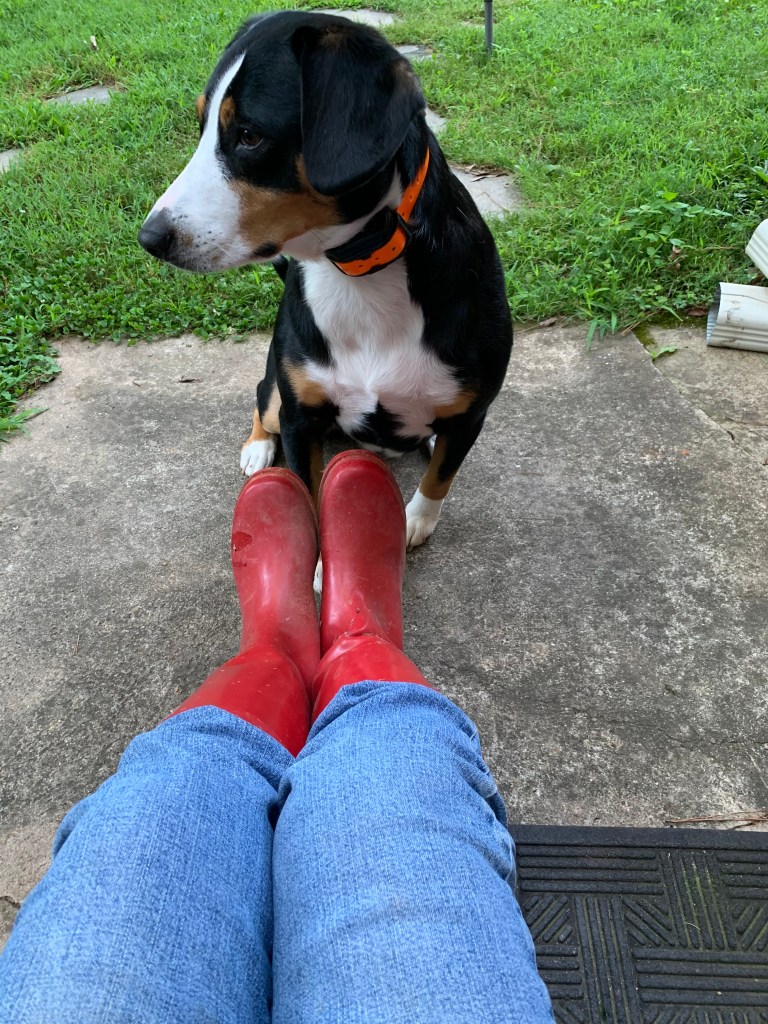
The stone path crunches as my dog, Journey and I walk towards the greenhouse, keeping a keen eye out for the languid resident rat snakes that need the sun to wake up and move out of the way. They like to lie on the warm paver stones which retain heat that the snakes cannot hold onto for themselves. They move along as I stomp my tall red rubber boots to make some noise and alert them that I don’t mind sharing space with them, but not too closely.
There are all sorts of sensory surprises strewn on both sides of this path. Breathing in, I fill my empty morning reservoir with the scent of oregano and peppermint and the sound of a dragonfly that buzzes close by my ear. Journey and I pause to pluck and chew a sweet basil leaf that offers up its store of calcium, vitamin K and antioxidants. The hummingbirds have been scarce this year, but this morning, two ruby-throated beauties are visiting the feeders and the whirring of their wings fills my creative well too. The feeders are a small gesture, one thing we can do to support a natural world that is struggling to show its importance.
We’ve lived here for nearly two years, slowly reclaiming the property and it’s existing gardens from a state of jungle ruin. In the process of reclamation, we became acutely aware that we are not so much masters of this space as we are temporary caretakers. We can guide colorful morning glory vines up the fence post and coax bright white moonflowers to climb the bridge, but a garden has a mind of its own.
A garden expresses its freewill in unexpected ways and challenges us to work with some tangles amidst the order we try so hard to achieve. It is a competitive scramble between the form that I seek to bring to this space and the randomness that nature prefers. I glance over at the gangly unidentified tomatoes that are volunteering and flourishing out of the compost pile while my carefully tended and pruned heirlooms contracted leaf curl and had to be uprooted and discarded. Nearby, a stray butternut squash has sprung up from a carelessly dropped seed and now it crawls along the leaf pile in an inconvenient location. It doesn’t seem right to pull it up given the obstacles it overcame to work its way to the top of that pile and declare it’s rightful place in the world.
It occurs to me that this backyard landscape is akin to my inner landscape these days. Just when I think I’ve got the television news somewhat figured out, up pops another surprise to contend with. I constantly have to back up, turn around and reassess to contend with situations I had not anticipated. I am challenged daily to navigate the tangle of weeds and vines to find the information I need to do my part to bring order to chaos.
Like the news, this living garden landscape sometimes feels so much bigger than me, especially when it resists my efforts to give it form. It’s aversion to taming challenges me to think in less linear ways. The garden’s willfulness demands that I put into perspective imperfections and carefully assess whatever existing inhabitant of this space wishes to express itself. Do I allow this one to remain in my garden? Do I cull that one to make room for a healthier more beneficial plant? It is a series of small everyday decisions that determine which existing growing thing stays or goes and what others are invited into.
As Arnie and I work to coax the land back, we’ve taken care not to eliminate any plant, shrub or tree until we are sure what it is. We have found a few that didn’t look like much, but given a chance, proved valuable plants. We try to research and inform ourselves about what will make a positive contribution to the whole.
The result may not meet our original creative vision, but we’ve been generously rewarded by discovering a number of plantings like
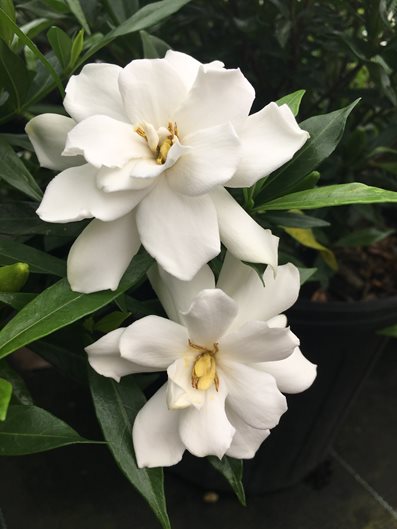
hibiscus and gardenia that had gone dormant when the jungle overtook them. In summer, the tall magnolia has been offering dappled sunshine to hidden iris bulbs that just needed to be gently exposed. They rewarded our patience by bursting into bloom when the choking vines were cleared away.
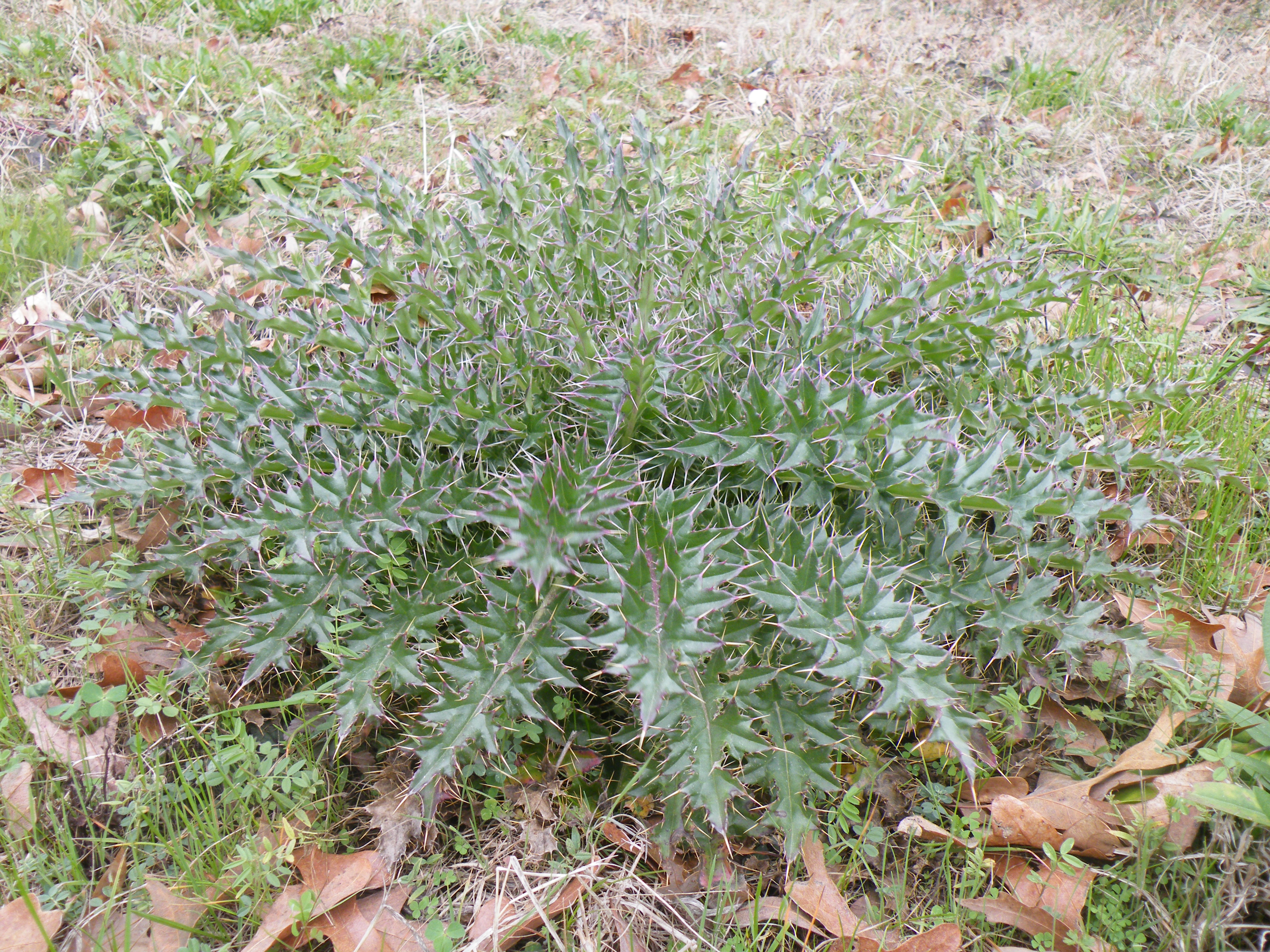
But then there is the thistle.
There is always a line, a boundary that is just unacceptable and for me, that is the thistle plant. I cannot and will not accept thistle and the former gardener here evidently felt a kinship with it, allowing it to proliferate. Thistle is the smug dictator of the plant world, intent on nothing but its own selfish brand of thorny invasion. Despite its proclaimed value, it’s aggressive and destructive nature is detrimental.
It does not play well with others when it imbeds its tiny thorns in Journey’s paw or my bare feet. It is greedy and given any bare spot, it will spread thousands of tiny hateful seeds in a bid for takeover with no regard for more fragile, beneficial neighbors. It is the metaphoric 1% of the plant world, taking for itself the wealth of resources that could be shared with others for the mutual benefit of all. With its distinctive head of hair, the thistle acts fast proclaiming to all that it is bigger, better, and more beautiful than all others.
In contrast to the thistle, the zuchinni florishes peacefully in the experimental “forest garden” across the creek and under the trees. Here, the existing soil is full of rich leaf matter and bark composted naturally over many years. The zucchini plants are nestled harmoniously alongside many of the native ground cover plants that live there, producing it’s bright yellow flowers to attract the bees needed to pollinate all the plants. I’m guessing that the natives are healthy and they have attracted interdependent worms, beneficial bugs and diverse nutrients that are welcoming the zucchini too.
These prolific squash plants asked for nothing special and needed no holes dug except that scraped with the heel of my boot. They have asked for no fertilizer and little tending as they offer up their contribution to our harvest. Here is nature expressing her generous vision and showing us the strength and wisdom of an ecosystem that has been built up over time and has plenty to share with all. The zucchini is the grateful refugee that has been welcomed to live in harmony with those plants that are already there because there are plenty of resources for all to share.
Our original drawings showed a happy garden with planned spaces for a riot of colorful perennials that encourage butterflies, bees and fairies to visit. It as to be a cross between a Monet painting and a stroll through Tasha Tudor’s famed gardens. I visualized it as a Zen place to sit and meditate. I’m holding on to that vision, but a whole lot more loosely than planned. A girl needs her dreams and I’m not giving up this fantasy completely, but right now this garden has more of a thread of black humor than light and airy fantasia.
I had not had time to fully accept the sad loss of the tomatoes that I had carefully nurtured from pricey seeds before the next round of black garden humor struck. My power tool loving husband weed-whacked one plot of butternut squash seedlings in a holy-hold-my-beer moment. I watched their demise from my vantage point on the second floor deck but couldn’t be heard above the motor. Good thing.
And I am not innocent in the doom and destruction department myself either. Last week, I tenderly sowed a new patch of cleome from seeds that my sweet neighbor lady shared with me. This morning I mistook the tiny sprouts for emerging weeds and yanked them all up. I should learn that if it comes up that easily when I pull, it is not a weed; it’s a seedling I planted. More black humor from the garden that seems to enjoy keeping me in my place.
The garden really is a great analogy for life itself. We do the best we can to sow good things and then we work hard to cope with the unexpected and sometimes unimaginable events and obstacles that life presents.
Maybe that’s how we can think about the current situation we are all facing in our country? Maybe we should face the tangle of perspectives, ideas and opinions that is America’s garden with as much informed intelligence as we can gather. Perhaps we could examine our own personal intentions and be sure that they are aligned with what is good for every person who wants to thrive and grow in harmony alongside us. Good gardeners do that. They do what is best for the whole, carefully tending and cherishing each individual at the same time.
Remember the thistle? We know damn well that when we dive in impulsively with our bare hands to pull up thistle, we are going to get pricked by thorns. If we approach the problem half-heartedly and without preparation, we will pay with painful wounds and a nasty rash. We may even scatter more thistle seeds unwittingly.
Instead, we could approach the task authentically and with courage, put on those gloves and work on the problem at its very base. Be tenacious, dig it out, and remove it. Treat it like the destructive weed it is, taking up precious space and blocking the beauty of the American landscape. Don’t break this weed off at its root and allow it to regenerate and reestablish itself. Get it all. Clear wide and deep so that we can plant something new and better for America’s garden in November.
Your vote is your shovel and with it you can remove the self-interested thistle that is spreading hateful seeds, all the while proclaiming that it is the biggest, best most beautiful plant in the garden.
When I swung my feet over the side of the bed this morning, I glanced at the notepad tucked on the bedside table. I keep it there to capture random thoughts generated by dreams, late-night reading or whispered night prayers. Although I have little recollection of making them, last night’s notes indicate that today, I plan to write something about stillness. Since right now is such a time of stillness and solitude this topic still holds a morning after appeal, so stillness it is. How shall I get going?
As the sun begins to nudge the night away, it’s very quiet morning here on the corner. The breeze is not yet stirring and the birds are just waking up over the creek. The dog has not cracked an eyelid yet. The wooden staircase creaks a protest in its own slumber as I creep downstairs, trying not to wake Arnie. I attempt to make only soft-slippered noises that are poetry to the stillness. coffee dripping, window shade rising, eggs boiling, dog kibble sprinkling into a ceramic bowl tiptoe noises of the quiet morning
I wrap two hands around a favorite chunky mug, steaming and swirling with creamy hot inspiration and soft-step back up the staircase to the chilly studio to write. This still time, the blank canvas of the day before the sun begins to warm the garden is a sacred prelude to abandoning the keyboard for the rake and hoe later in the day. The solitary early morning is a precious, protected time.
Sitting down at the desk, I glance up at a ratty hand-written paper list of much-admired writers that peers down from the studio wall in encouragement. If the well goes dry, I only need to take down one of their books from the shelf and the creative log jam is loosened. I’m only looking for a keyword or sometimes a snippet of profound thought to get going. The bearded three, Emerson, Thoreau and Muir, are at the top of my nerd list for subject matter when I want to write something that is contemplative like today’s subject matter of “stillness”. So, this morning I will start with these three venerable gentlemen for inspiration. Their wisdom translates easily into our urbane day to day life and proves that great thinking is timeless.
This is a writing exercise that I often use to get started:
Read a quote from a writer that you admire and then put it in a pan, boil it down and apply it as a salve to something you are dealing with today. Ask how you can find insight by reading the thoughts, philosophy, beliefs or opinions of great thinkers. You don’t need to agree, you just need to stretch your thinking to gain insight and in the bargain some practical applications that will help you gain perspective! I’ll share with you the three quotes that I chose today. I list the quote first and then talk about how it might apply to this very day, Sunday April 5, 2020 and what might be going on in our world. If you are so inclined, I would love to hear who you are reading and gaining insight and inspiration from. How do their thoughts apply to your days? What insights into your daily life are you gleaning? Please feel free to leave a comment. #1 Emerson: “As we grow old, the beauty steals inward.”
Today’s Application: Over the last few weeks, I see more clearly the absolute beauty in my women friends who have let go of make-up, slid into relaxed clothes and shared musing among a sisterhood who cannot get to the salon. You were beautiful before, but you are even more beautiful now as you reject outward appearances and embrace who you are as a person. You inspire me with your adaptability and make me laugh with how you take it all in stride. I hope your day is simply fabulous with solitude and stillness.
#2 Thoreau: If we will be quiet and ready enough, we shall find compensation in every disappointment.
Today’s Application: We are expecting a new grandbaby in a couple of weeks and this time, we will not be there. He will arrive in Massachusetts while we pray for him and his Mom to be safe and healthy from our home in Georgia. It seems that an insurmountable distance separates us at this moment. But we can only be quiet-minded over this unexpected global event that is out of anyone’s control. We are only in control of how we react to being distanced from our family at this particular time. So, we accept that the quiet time given to us right now is meant to ready us for the compensation that Thoreau suggested is there. As with all of life’s mysteries, we don’t know what that compensation is yet. We only know that it is there, waiting in the stillness and that it will welcome us all back together when the time is right.
#3 Muir: “There are always some people in the mountains who are known as “hikers.” They rush over the trail at high speed and take great delight in being the first to reach camp and in covering the greatest number of miles in the least possible time. They measure the trail in terms of speed and distance.
#3 Today’s Application: Words from Muir, the third bearded gentleman, will usher me outside into the garden. His words will remind me that today I have plenty of time to slow down and place my steps carefully. I will walk the same path ten times to carry water to newly planted seedlings, but I will do it mindfully and not step in the same footprint twice. I will vary the path to allow the tender grass sprouts between the water spout and the garden to continue to poke up through the dirt and provide cover to the hard red Georgia clay. I will cohabit with them gently so that we may both thrive. I don’t need to water fast, I need to water well. I’ll garden today with an eye to everything that might get trampled if I make the mistake that Muir cautions against and “measure the trail in terms of speed and distance.” I take time to be slow and still in the garden.
I hope we emerge from this quiet time knowing things we did not know before. If nothing else, know this: in the quiet of the morning, in the still of the night, in the solitude of being separated from you, I want you to know beyond a shadow of a doubt how much I love you. One inevitable tomorrow will be the last that we will share and when that day comes, I want you to know that I will continue to love you in that sacred stillness too.
This post is to offer encouragement to my fellow creatives who are struggling with the various emotions that result from being confined.
It is different for everyone, but for some artists I’ve been talking with, this suspension of movement has a hidden positive side. The reduction in constant contact seems to be a pleasant respite for some. Despite the anxiety of an uncertain income, some of my creative friends are reporting that they are finding themselves pretty productive without the hustle and bustle of daily life demands. Long hours in the studio or at the writing desk are possible in the absence of many typical daily interruptions.
Other artistic friends that I’ve spoken with report that they are chafing at the separation from friends, family and routine. Cabin fever is setting in and along with that a variety of unpleasant emotions that impede their ability to get into the studio or out in nature to create. Without the flow of ideas stimulated by in-person contact, their muse slowly dries up and they are faced with a creative block.
I fall somewhere in the moderate middle. I am loving the quiet and the solitude to work without interruption. On the other hand, I sure could use a good hug! I seem to have a strong impulse right now to remain connected in my community of artists and to know that they are well, so I’ve been reaching out to talk in person with artist and musician friends by phone, by Facebook and video chat. We are supporting one another in new and different ways and appreciating one another crafts even more than ever.
It’s such a conundrum. We have the ironic ability to save the world by sitting on our couch… keeping others safe by keeping a distance. But maybe we could contribute more expansively by sitting at our desk or in our studio and using this time of stillness to create. Maybe we can retain our purpose but adjust our practice? And what is our purpose as artists right now? Is art even relevant?
I have long believed that the purpose of all art forms is to make us think. That goes for visual art, graphic art, music, writing, etc. Neither the art form nor the technical skills of the artist matter whatsoever. It is the creative expression that matters- that indefinable process of contemplation that calls the artist to the drawing board. The introspection and tuning into our inner lives and emotions are what counts right now.
Let’s ask ourselves a couple of questions. How can we use our creative expression to bring comfort, compassion and joy to those who are suffering. How will you share your art to uplift our people and our country through its time of crisis? What new thought can you share, what song will you write? What poem will call out to our people to unite, ignite and incite for good?
Here’s a great example of how sharing your art can ripple. Thank you to Bruce and Cheryl who shared one of Bruce’s paintings with me on Facebook yesterday. Looking at the beautiful piece sparked a focus for my meditation this morning. The mantra I paired with Bruce’s landscape study was Peace Like a River. Peace like a River is a chant song that is very meaningful to my friend Rosie and when she sees the painting on my Facebook page, I am sure she will hear that song in her soul. It has played in my head since we sang it at her Mark’s funeral service all those many years ago. We humans find comfort in connection. Art connects and surely has an important role right now.
A second example: just last night we joined two young Massachusetts singer-songwriters on Facebook live while they shared a few songs from their upcoming album. Their lyrics and soothing harmonies brought us comfort and a respite from the usual evening television routine. They reminded us “don’t fan the flames of other people’s fears” and that “being good isn’t a contest”. I slept well and woke refreshed and ready to get to work on this blog post after listening to Mark and Raianne’s heartfelt work.
And our dear friend and author Larry Butler is offering his entire collection of books for free right now. We need ideas that are informed, intelligent and outside of the box. Here is Larry’s invitation to take advantage of his generous offer.
“During this trying time we may become so bored at home that we’re reading books we might not touch under normal circumstances. For the duration, I am making the library of e-books I’ve written available to anybody who wants them free of charge. This includes you, your family, and your friends too. The books deal with the issues of economic inequality and public policy, with special emphasis on debunking popular myths. Send an e-mail to techcfo@yahoo.com and specify the title(s) you want to receive, and the format you prefer to read. The link takes you to my Webpage where you’ll find a brief description of each title.”
This time of enforced quiet is a gift to the creatives that we must use wisely. We must be still and look inward to touch all of the emotion that fuels our art. When we come through the fire we will explode into a new world of creative expression that will inspire the universe. I am so sure of it.
It’s pretty insane out there right now. Grocery stores are emptying out at an alarming rate. People are hoarding goods and services are shutting down. Extreme religious and political opinions are circulating on social media right along with unreliable information. The challenge for us all is to resist being the critic and embrace being a force for good.
We will all be affected in significant ways. But we still have comparative abundance. It’s time to be sure that our abundance is shared equitably and that each and every person, business, church, school and non-profit organization looks outward and forward for creative ways to take care of each other. And if you can find the humor in any of this, please do so. It can’t hurt to have a chuckle at ourselves while we get through this all together.
Here are some events from the past few days that have made me ask, “Why? Just why?” Just why #1: Water
I went to the store and there is no water on the shelves. I don’t understand why there is no water since I haven’t seen that the virus is threatening our water supply and my tap still seems to work. So, why are we hoarding water? At least I still have half a bottle of gin. I’d be happy to share it if you want to come over. Please bring the tonic. The store was out of that too.
I do need to buy distilled water for Arnie’s CPAP machine. Without that machine, his life is in grave danger. Mind you, the danger is not from the device, but from me. If we have to go back to his bone-rattling snoring every night because the machine won’t work, I will lose my Girl Scout cookies.
As a backup precaution, I plan to order one of the supersize My Pillows just in case I have to smother him myself. That’s if I can even get a supersize My Pillow. Maybe people are hoarding them too?
Just why #2 Toilet Paper
People seem to be struggling with the existential question of how they will live when the toilet paper runs out. Maybe this is how we will die; constipated because we are afraid to use the potty without cupboards and closets full of paper in reserve. But do we need advanced wiping technology? Our ancestors’ age-old struggles to find creative ways to clean up their nether regions should give us an appreciation of the Golden Age of Wiping that we are enjoying in 2020. We have left behind (no pun intended) sticks, leaves, stones, used newspapers and the Sears catalog. If the empty shelves are any indication, we are now 100% splinter-free and deathly afraid to go back.
Just why #3 Keeping a Stiff Upper Lip
Ladies, we grew up being told to keep a stiff upper lip. But ponder this. What if the stores run out of razors? What if postmenopausal women everywhere are not able to shave their upper lip? They will practice social distancing willingly rather than risk the humiliation of five o’clock shadow. And if the still-fertile generation of women cannot get razors because you are hoarding them, the birth rate will plummet and the human race will not survive. Evidently, this is a clear and present danger because the store was out of razors.
Just why #4 Anxiety Induced Distraction
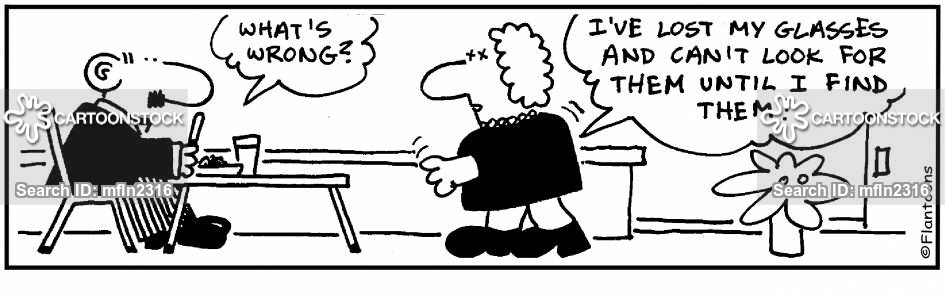
I’m so distracted trying to keep up with the latest news. Now, I can’t find my glasses. I put them somewhere this morning when I was busy trying to decide what to take care of first. Looking for them is an exercise in futility anyway. I can’t see the glasses without the glasses.
I was distracted because I was distracted with trying to set reasonable priorities. Should I go out to hunt and gather for water? Should I rip off rationed sections of toilet paper and hide the rest from Arnie so it will last longer? Should I go to the computer and develop an algorithm for how long my last two pink disposable razors should last a woman of my advanced age before I succumb to The Shadow? If I can scientifically predict how long two single blade razors can last, I can ration the number of shaves per week. Information is power.
Arnie helped me look for the glasses. We searched for twenty minutes and tore the house apart with no luck. I didn’t want to buy a new pair because I blew my monthly budget of Clorox wipes, canned vegetables and dry pasta. The glasses were in this house somewhere and the dog didn’t look guilty. I just needed to find them. While I was putting away all of the pre-apocalyptic grocery supplies in plastic tubs and reminiscing about my Dad’s 1950’s nuclear bomb shelter, I leaned over and the glasses fell off my head where they had been all along.
But let’s get real. These are not signs of some catastrophic end of days. Stop all the nonsense tribulation talk on social media. You are scaring yourself and vulnerable others too. The buying frenzy, while troubling and morally questionable, is predictable human behavior in response to uncertainty and anxiety. Stop adding to it. While we are not in control of events, we are in control of how we respond to them. And now is an opportunity to exert some self-control and adjust how we are thinking about our present circumstances.
Now is an opportunity to find new ways in which to change our behavior and conserve on products that we overuse anyway? We are amid a wake-up call to live more lightly and take less for granted. It could be that this is a warning call to change our behavior and tread more reverently on our Earth and on each other.
Today, I will pack two bags. In them, I will put a jar of spaghetti sauce that is cooking in the crockpot, a loaf of banana bread, a roll of toilet paper and a roll of paper towels. Then I will walk over and ask my two elderly neighbors if they are all set. Since we are likely headed towards being cooped up in the house in self-quarantined for a period of time, I’ll remind them that we both have charming front porches to sit and visit on. This will be an excellent time to get to know one another in a deeper more meaningful way.
This is not the end. Let’s make this where we begin.
Yesterday, we said good-bye to our dear little Wicca. Every dog that we love is extraordinary to our hearts and Wicca was no exception. She was a wise and scrappy street survivor, a graduate of the Pinellas County Humane Society and she had the magic. Blessed with a Budda nature, she was joyful and kind. This upbeat, funny old soul was the love of our lives for all of her nineteen and a half years. She was also the boss of us.
Putting grief and loss in perspective is different for all of us. We all have to move through it at our own pace and in our own way. Runners run, carpenters pound nails and writers write. Recently, I submitted a story to a short fiction contest. This morning the story seems to have new meaning and re-reading it gave me a bit of perspective and a smile. I’d like to share it with you as we begin a new day with gratitude for the moment that Wicca entered our lives and every day that we had with her after that.
Fairy Riders
by Barbara Wentzell Jaquith
3/13/2020
My grandfather Aiden was generally considered strange. Not by me because I loved him, but by everyone else who knew him. Granny loved him too even though I think she was real hard on him. She did not much like it when he filled our heads with Irish stuff, and she let him know when to shut up with the old stories.
At the foot of his bed, he kept a fiddle and bow in a beat-up steamer trunk and a big bible that he didn’t take out as often as the fiddle. There was a handwritten list of relatives from Dublin on a yellow piece of paper folded in the bible, two striped cotton shirts, one yellow silk neckerchief with blue flowers and a waistcoat. A smelly old pair of work shoes and a brown hat had some sort of meaning to him. Tucked in the brim of the hat was a faded picture of a black and white border collie in a crouched position, eyeing a small flock of ragged sheep. On the back of the photo it said Da and Trusty 1890 in shaky cursive handwriting. One time he pulled the hat and shoes out and showed me hiding pockets where he brought money over on the boat when he came to America. He kept all these treasures in that trunk, but his stories were kept safe in his head.
Granny got especially mad when Grampy Aiden mentioned fairies. She said Irish people stick out enough without him calling any extra attention to us. When he told stories, she would tell him to shut it and slam kitchen cupboard doors. So, he mostly shut it around her.
But some things just have to come out of a person or they fester. That’s how it was with the stories. Grampy used them as a healing ointment. Whenever we skinned a knee, Granny pulled out the stinging mecuricome and swabbed it on while we howled. But Grampy’s cure was better received. He had a way of speaking when he was story-telling that was like a balm. He spoke his stories with a soothing lilt that turned our minds in a direction. He knew the hard part of healing is figuring how to let go of the pain and move on.
I was a real little boy when my parents got dead in the crash and Grampy’s farm collie was my crying pillow. His soft brown fur sopped up tears real well and he lay down beside me as a buffer from Granny’s own grief and rage. We called him Ben. At the time, I didn’t know about the fairies. We were out in the garden the day that Grampy told me about them. I think he conjured a story for me because Ben had just got sick and died too and I was feeling real empty.
My Grandfather Aiden’s hands are so big that he takes a second helping of soil when he digs spring carrots in the garden. He takes the time to loosen the roots with a trowel before he yanks them up by their green lacy tops. Then he knocks them hard against his overalls to get the dirt off. He’s big, but his hands are always easy when he passes me one. They are still warm from the sun and crunchy from the winter’s underground rest.
The day Grampy told me about the fairies, he didn’t look up from the row. He just started talking right out of nowhere. “Do you know about fairies, son?”
“I know Granny says there aren’t any.”
“Granny hasn’t seen them because Granny doesn’t believe, so they stay shy and hard to see around her. It doesn’t mean they aren’t there. They are travelers and only go where they feel welcome and useful. When I light the cook stove in Granny’s kitchen and a puff of smoke escapes, that’s fairy smoke signals. You just have to be still and understand that they are there so you are not alone. Fairies are there to help you.”
“Are they here right now?”
You will now there are fairies about when the breeze blows on your face. When the sun casts a play of light through the leaves, that’s a sure sign of fairies. See the dandelion seeds blowing over there in the field? Those are fairy letting us know that they are near.”
I like the stories even if my grandmother doesn’t like him talking to us about that sort of thing. Maybe she’s got a point when she says that talk about banshees and fairies and second sight is not suitable for little kids. But how would I learn that it’s not just us alone in this garden and in this world if Grampy didn’t teach me that kind of Irish stuff? Because of him, I know that you don’t swat an insect buzzing around your head until you’re sure it’s an insect. Bugs and fairies look pretty much alike until you can get up close, and it’s hard to get close to a fairy.
“ I want to see a fairy for real.”
“You have to spot them when they pause to take notice of something.”
“When’s that?”
“There is one thing that will cause fairies to pause and take notice every time. Fairies know when a new puppy gets born.”
“How do you know this?”
“Big men know about small things.”
“Will I ever see one?”
“Maybe, but until you do, it’s a mystery and you just need to believe. Let’s go sit in the shade under the tree and I’ll tell you a story about dogs and fairies. Not a word to your grandmother. This is a story for you and me.”
Grampy set the trowel point down in the dirt, brushed off his pants and headed over to the shady spot. Easing down onto the grass and settling into a comfortable position with a wince, he took up a story about fairies and dogs.
“You’re most likely to see a fairy around dogs because fairies hitch a ride on the dogs back whenever their wings need a rest. You can’t always see them, but you know they are along for a ride when the dog sits down and lifts a hind leg to scratch. You think its fleas, but that’s not it. When a dog scratches, it’s because there’s a fairy rider on his neck and it tickles where she is holding on.”
“Ben used to scratch a lot but I never saw no fairies.”
“That’s because you didn’t know about them then. But they were always there. Remember when he would stop and just look sideways like something invisible was buzzing around his head? That was his fairy talking to him. Or, when he chased his tail? His fairy was playing with him. The fairy riders chose a puppy that they like and then they stay with that dog all of his life.”
“When did Ben get his rider?”
“When a new puppy takes its first breath, a fairy hears its tiny cry and she hurries to welcome the new life. This is how it begins. When the puppy is ten days old, its eyes open on the world for the first time. The fairy gets all tearful when her puppy looks into its mother’s eyes for the first time. She watches and cheers when it loses its first tooth. When the puppy is a month old, he stands up to play with his brothers and sisters. They wobble about, fall right down and roll over on their backs. Fairies riders giggle when puppies learn to play. It’s like riding a clumsy elephant that keeps falling and getting up again.”
Grampy pulled up a long blade of wild wheat. He ran his fingers down it, shucking off the golden seeds at the top and letting them fall. He tied the pliant reed in a neat bow while we just sat quietly for a minute before he took up the story again.
“One day, a new family comes to take the puppy home with them. The fairy has to watch over things very carefully at the time when her puppy leaves its mother. When the puppy finds just the right human, the fairies clap their hands and laugh right out loud.”
“Grampy, you know Gramma is going to be mad that you are telling me Irish stuff.”
“Well, she would if she found out, but she’s not going to is she?”
“Nope, she’s not. Tell me more.”
Grampy shifted his weight and went on. “The riders go along on all their dog’s adventures. They work in the field, protect homes and heal broken human hearts. People don’t even know they are there, sleeping in the ruff of an old collie. Remember how Ben’s coat used to glisten in the sun? That sparkle was his fairy’s wings. Through all of Ben’s life, his fairy rider was right there with him holding on for dear life even when he ran around in the meadow or went swimming in the creek. And then one day, Ben’s fairy noticed he was slowing down. His step wasn’t quite as spry. His legs were stiff and getting up off the ground was hard.
“Like you, Grampy?”
“Yes, son, just like me.”
“Ben got slow Grampy. One day he just laid there and he couldn’t get up at all.”
“Yes, he did. And when that happened to Ben, his fairy was there. Just as he was falling asleep, she climbed up close to Ben’s soft ear and whispered something. If you were very close by and very quiet yourself, you might have heard it, son.”
“What did she whisper?”
“Well, when it’s time for a dog to leave us, the riders all say the same thing. It’s a gift they whisper like a prayer to old dogs.”
Ben’s fairy said, “Good and gentle creature, you have been my companion through rising suns and falling moons. You have kept me warm in the field and safe on the mountain when you brought in the sheep. It has been an honor to be your rider and guardian, but I sense now that you are tired and can carry me no more in this life. I know that you must go. I bid you quiet passage and thank you for allowing me to be your companion for all this time and especially at the time of your leave-taking. Now, do not stay for me, but go in peace as you must.”
“And that’s how he left?”
“That’s how he left.”
“Where is Ben’s fairy now?”
Grampy Aiden looked right at me then and he seemed to be smiling deep into the well of my sadness. “Even though Ben had to go, his fairy still had work to do, so she wiped off a tear, turned and flew away. You see, she had just heard a new puppy’s cry in the distance and she had to be off to meet him. Her job was to pick out a new puppy and be his new rider.”
My grandfather, slowly got to his feet and bent over to rub his knees for a moment. “Now, go get washed up, son. We need to visit the farm next door. They have some new collie pups and one’s meant to be yours.
“Oh, Grampy, thank you! How will I know which one is meant to be mine?”
“Big men know about small things.”
The arduous work of bringing a book to market is done and I am just now looking up from the mire to begin a new writing direction. The piles of drafts and editors’ notes are organized and filed away. The desk surface is neatened up. New ideas are percolating and I am working with the good writing team around me to identify the perfect next project. In the interim, I’ll get a few blogs off and hope that they find you all happy, healthy and doing good things.
Someone recently asked me how writers start a new project? Do they just sit down at the keyboard and start writing? It’s different for everyone, but for me, getting outside on a trail shakes out the cobwebs. Creative thoughts are always there, but there is often a lid holding them in the pot. The lid consists of all of the necessary daily details that keep us too busy to open up our best thoughts and find insight. John Muir said, “I only went out for a walk, and finally concluded to stay out till sundown, for going out, I found was really going in.” Being in nature relaxes my mind and loosens up my creativity.
This morning, I headed over to a local hiking trail with my four-legged hiking buddy Journey. We headed into the woods to explore a new trail for a couple of hours. On this blue-sky day, she and I walked beside the marsh that is coming alive with birds just arriving from their migration. The spring birds are coming back to Georgia now and it is musical in the woods. They are very busy gathering twigs and grasses for nests and calling to prospective mates. Spring here generally runs from March to May, but the first stirrings of spring are in February. This morning we saw a few gnatcatchers and vireos. Louisiana waterthrushes are also arriving early and were singing along the water’s edge. A long red-winged blackbird added a spot of color and we could hear a woodpecker in the distance. The American robins are back and building their nests and mourning doves are working on their spindly stick nests.
Journey is fine company today as we walk along together. We start out doing mindful walking (1) and she selflessly slows her pace to match mine. I am seeking insights that cannot come with a hurried pace. Does this sentient being also gain insight too when she slows with me to make careful observations? I think so.
I love the challenge of mindful walking with this dog. Journey comes from a long line of herding dogs who are born and bred to work at a tireless pace. Entlebucher Mountain Dogs are muscled, intelligent cow dogs who need a job to be happy. Her brain is wired to move boundlessly and take control, so it does amaze me that she has the capacity to think insightfully and adjust her pace to the old lady that she ended up with as her life partner. Since she has no herd, Journey’s job is taking care of her people and she takes it seriously. She and I work together to balance her play and work energy with a variety of introspective endeavors so that she can do that job well. Yes, I teach mindfulness to my dog. Or, rather, we practice it together.
This morning, we practice mindful walking on the trail. We take a few moments before heading out to touch the earth and feel our bodies. Starting out, she lies down, belly in the dirt and I bend down, placing my hand on the ground beside her. It is still chilled from the February night. Next, we both stand, relaxing into that simple posture.
“We have nothing to do and nowhere we have to go, Journey. We are just here.”
As we move forward, we notice the sensation of our feet and legs moving, the pressure on our soles and the stretch and bending of our toes. I pause, bend down and touch her feet, picking them up one at a time. “Those are your beautiful toes.” She looks up at me and back at her feet showing me the soulful whites of her eyes. She seems to understand that I am asking her to pause and notice something. We walk forward again with our four paws and two boots in constant and steady contact with the earth as I recite a walking mantra, a thought worth repeating, to her.
“Be still, Journey, easy be. Gently go, gently go. Be still Journey, easy be. Gently go, gently go. Be still Journey, easy be. Gently go, gently go ”
Later in the hike, we walk more briskly and I talk with her as I dictate notes to use to write with later. Capturing observations on the smartphone allows me to preserve the essence of the moment for later reflection and writing. Having a process streamlines the endeavor and eliminates any concerns about whether or not I’ll remember it later. Speaking those observations out loud keeps Journey tuned in to the fact that we are walking together and not having a separate experience.
When Journey and I walk together, we meet each other in the middle. She accommodates my arthritic knees that regulate our hiking pace and I acknowledge that she has a young dog’s need to sniff, explore and play.
We take turns being as one in the woods, entwined as human and dog in an age-old bond.
It is a dance of accommodation, of mutual give and take on this walk today. She moves a measured distance ahead, turns and then trots back to allow me to hold her harness up the rocky hill. She leans into the harness and pulls hard to assist me with the momentum needed to climb up for the view. Descending the other side, she walks slowly beside me, steadying me on the slippery gravel underfoot. My companion and I are tethered less by the harness and more by the relationship we have.
The gravel crunches under my hiking boots while she walks on silent pads. She’s stealthy, but try as I might, I make too much noise in the woods. Sometimes we stop and sit to hear the voices of the forest. I take her cue and sniff the air too. What is the musty mushroom smell? Is it the lichen that is greening up everywhere that has an earthy odor. There is a hint of a skunk who was startled in the night. The woods feed our senses.
We help each other. I am the human with the driver’s license, so I drive us to the trailhead. I plan some favorite snacks and water to take along and she helps me to slackpack by carrying the weight in her backpack. I help her avoid the fallen prickly seed pods on the trail and we both watch for snakes.
Journey keeps a keen eye out for the cooperheads that are waking from their winter’s rest. They are still sluggish, but awake and cranky enough to object to being disturbed. We live on a creek and Journey has encountered snakes often enough to be on alert. Her nose goes constantly, and her eyes scan the trail ahead. Her alert is unmistakable. She stops, freezes and fixates at a point on the trail where I can see nothing at all. She steps in front of me, blocking my path until I can locate what she is pointing out. And there it is, just off the side of the path ahead, in a sun-soaking curled copper circle. I reassure her and we move carefully in a wide berth around this fellow-creature who was there first and means us no harm as long as we pay proper respect.
Today is precious. The sunshine sinks into our winter skin, a welcome interlude before the rain that will come surely tomorrow. If not literally, the sunshine will fade into another of life’s challenges and we will be better equipped to cope by having made this walk today, We are refreshed, renewed. In a moment of trail kindness, another hiker offers to take our pictures together and this one moment will someday be a precious memory of a young dog and an old woman who were companions for the Journey.





 This post is to offer encouragement to my fellow creatives who are struggling with the various emotions that result from being confined.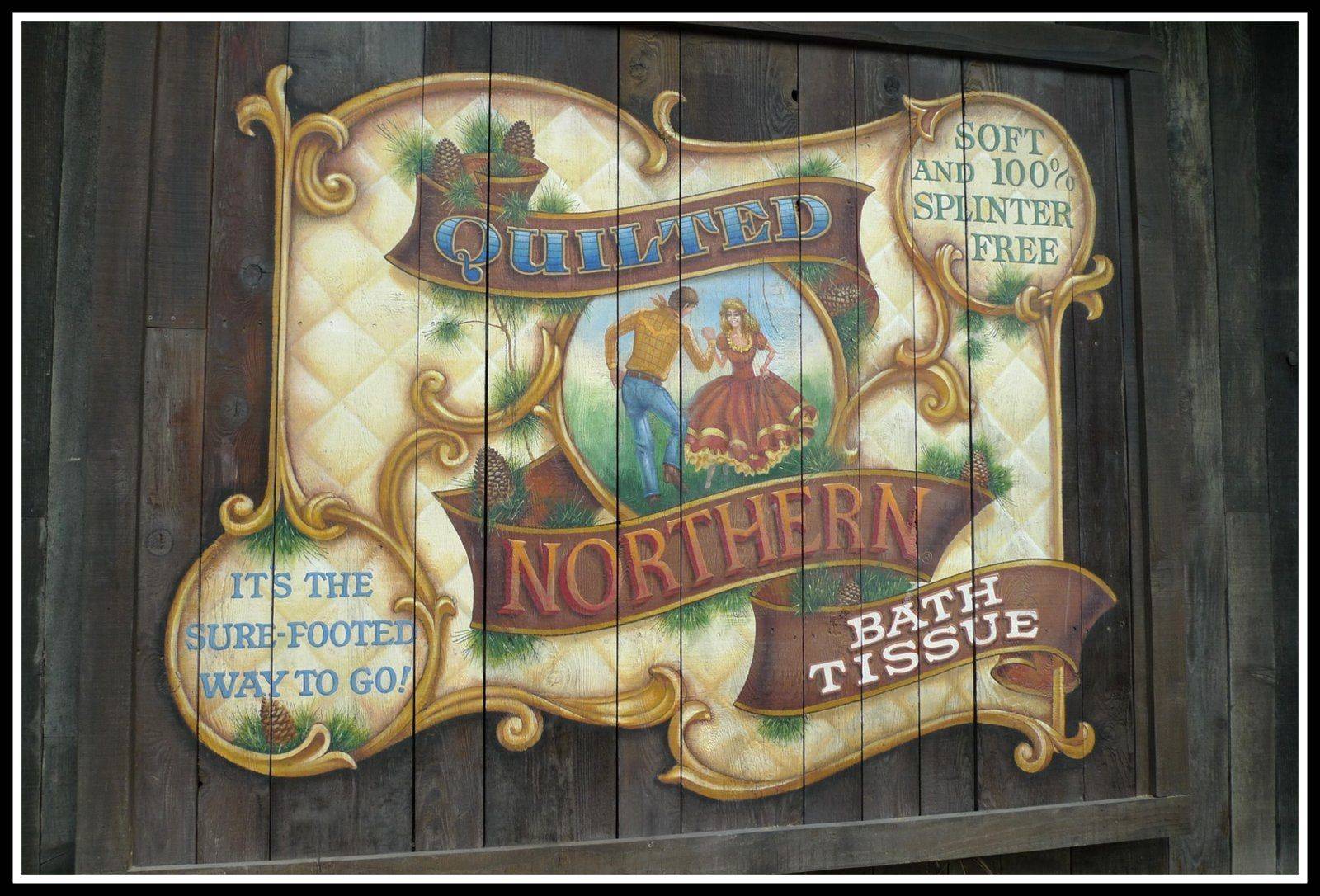


 Lovering Studio: A Wanderful Life
